




Which is better for getting a job faster: online IT courses or traditional IT training?
The technology business is doing very well. According to CompTIA’s “State of the Tech Workforce 2024” report, the tech workforce will grow by 3%, adding more than 300,000 new jobs this year alone. But even though there is a huge need for developers, analysts, and engineers, thousands of them are having trouble getting their first job. They are stuck in a loop of never-ending tutorials, confusing career advice, and emails saying they didn’t get the job.
Most of the time, the problem isn’t that people don’t try hard enough; it’s that they don’t know what to do. Should you spend years getting a degree from a university, or can you get ahead in your career with a six-month bootcamp? This is the debate between online IT courses and traditional IT training. The answer isn’t just what you learn; it’s also how quickly that learning leads to a job offer.
This guide will help you cut through the noise and compare these two paths based on the most important metric: how quickly you can hire someone.
The Real Issue with IT Training These Days
The harsh truth about the current education market is that we have more courses than ever, but fewer people who are ready to work.
Many universities and traditional training centres still use curriculums that were made years ago. By the time a student graduates, the specific frameworks or tools they learned might already be considered “legacy” technology by cutting-edge startups. On the flip side, the internet is flooded with unverified courses promising the world but delivering very little substance.
This gap is being noticed by employers. They aren’t complaining about a lack of applicants; they are complaining about a lack of practical skills. They see people who can write an essay about the history of computers but can’t fix a simple app or set up a cloud server.
Why This Choice Could Make or Break Your IT Career
It’s costly to pick the wrong training path. We’re not just talking about the cost of tuition, which is high, but also the cost of time.
Imagine that after four years in a traditional program, you find out that you need to spend another six months learning the tools that companies use today. That means years of lost money and career growth. On the other hand, taking a low-quality online course without a mentor can give you a certificate but not a portfolio.
The risks are high. Agility is everything in a field that changes as quickly as IT. You need a learning path that doesn’t just teach you theory; it also gets you ready for the technical interviews you’ll have next month, not next year.
What Traditional IT Training Offers (And What It Doesn't)
For a long time, the only way to get into the field was to get a computer science degree or go to a physical trade school. Even though the landscape has changed, traditional paths are still useful.
Advantages of Traditional IT Training
No doubt having a four-year degree gives you a huge theoretical edge. Traditional training is great at laying a strong base. You learn the “why” behind the code by getting to know algorithms, data structures, and system architecture in great detail.
Also, degrees are recognised all over the world. For some legacy companies or government jobs, a formal diploma is sometimes a must-have for HR.
Limitations of Traditional IT Training
Speed is the biggest problem with traditional education. Changing a university syllabus is a bureaucratic process that can take a long time, sometimes even years. In tech, a year is a long time. This often means that students learn how to use older versions of software.
In addition, traditional settings often put more emphasis on academic rigor than on hands-on learning. You might spend a whole semester learning about database theory, but only a week actually building and using a database. This means that there is a gap between what you know and what you can do.
Why Online IT Courses Are Becoming Very Popular
Job-oriented online IT courses are changing the way things are done. Most of the time, these programs are made backward from the job market. Course creators look at what companies are hiring for right now and make a curriculum that fits.
Benefits of taking IT courses online
The main benefit here is that it is relevant. An online course can be updated over the weekend if a new version of Python comes out or a cybersecurity threat comes up. This makes sure that you are learning the skills that are in high demand right now.
Another big factor is flexibility. You don’t have to quit your job to learn new skills. You can learn late at night or on the weekends, which means that people who want to switch careers can do so without losing their income.
Common Problems with Online IT Classes
It’s easy to make an online course, but the quality can be very different. There are a dozen surface-level video series that leave you stuck when the code breaks for every great, mentor-led bootcamp. It’s easy to lose motivation or get stuck in “tutorial hell,” where you can follow instructions but can’t build anything from scratch, when you’re not in a classroom.
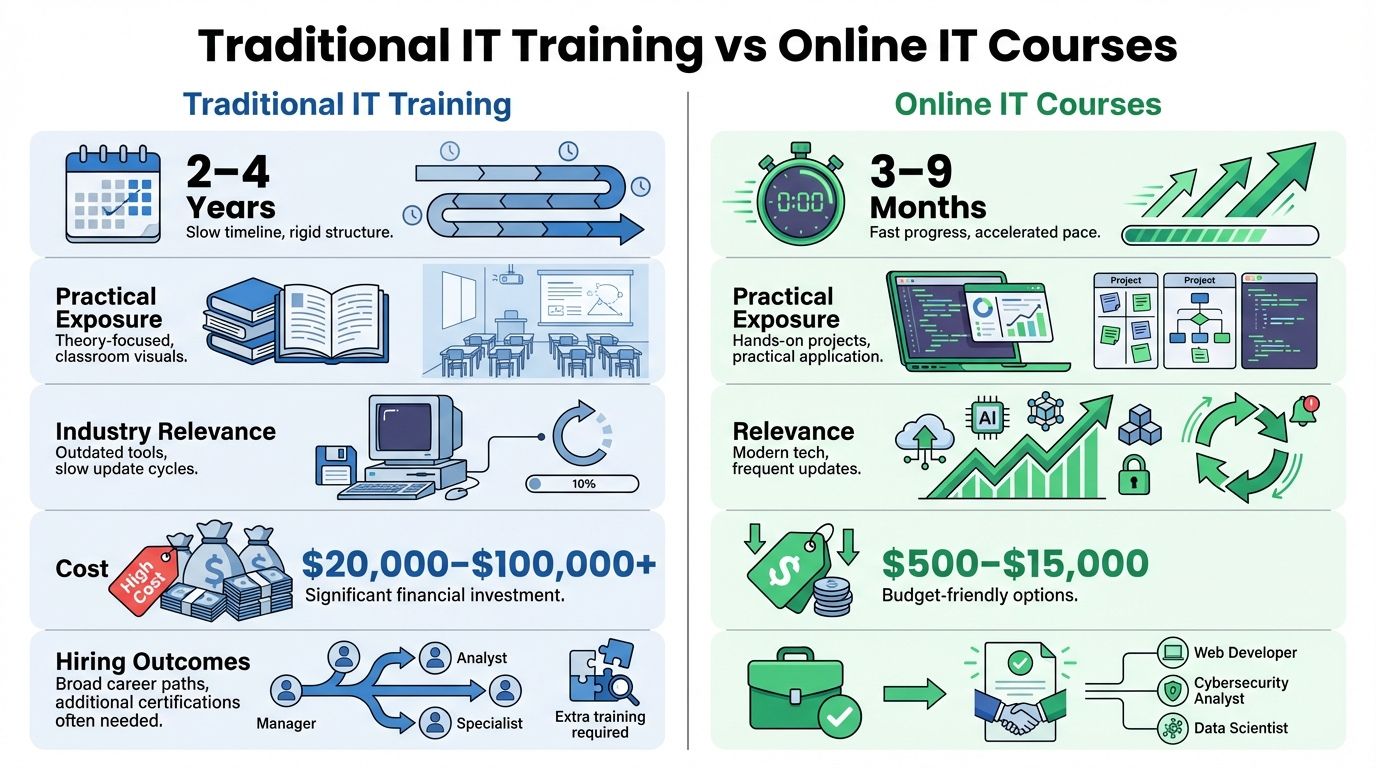
A side-by-side comparison of online IT courses and traditional IT training
When you look at the two choices side by side, it’s easy to see how they will turn out differently.
What Employers Really Want to See Before They Hire
You need to look at who is hiring to find out which path is faster. There is no doubt that the trend is moving toward skills over pedigree.
According to data from the Indeed Hiring Lab (February 2024), 52% of job postings on Indeed in the U.S. no longer require any formal education. Also, the number of job postings that require at least a college degree has gone down from 20.4% to 17.8% in the last five years.
What caused the change? Because hiring based on skills works. Forbes cites research that says hiring people based on their skills is five times more likely to predict how well they will do at work than hiring them based on their education. McKinsey backs this up by showing that workers without degrees who are hired based on their skills tend to stay in their jobs 34% longer than those who do have degrees.
Employers want to know if you can do the work. They want GitHub repositories, live projects, and certifications that show you know what you’re doing. They care less about where you learned and more about what you can make.
Which Choice Will Get You Hired Faster?
If you want to learn quickly, online IT courses with job placement help are the best choice.
Training the old-fashioned way is a long-term plan. It gets you ready for a career that will last for decades, but it takes a long time to get started. You have to finish your degree first, and then you usually have to teach yourself the modern tools you need to pass a technical interview.
Skill-based IT training that takes place online is all about the sprint. These classes shorten the time frame by getting rid of general education electives and theory that isn’t useful right away. With a rigorous online bootcamp, a focused learner can go from having no knowledge to being a junior developer in six to nine months.
More importantly, online courses that are focused on getting a job often offer career services like resume reviews, practice interviews, and direct referrals to hiring partners. This closes the gap between “learning” and “earning” much faster than a university career centre usually can.
When it still makes sense to get traditional IT training
Not everyone should go online, though. If you want to work in very specialised fields like theoretical data science, artificial intelligence research, or hardware engineering, you may still need a traditional degree.
Academic institutions give these jobs the deep math and science support they need. Also, if you want to become a university professor or work in a field with strict licensing rules, the traditional path is the only one.
How to Pick the Best IT Training Path
You need to block out the noise if you choose the faster route. Not every online course is the same. This is how to make sure you choose the right one:
- Look at the demand for jobs: Don't just choose a course because the name sounds cool. On LinkedIn or Indeed, look for the job title. Are people hiring for it?
- Set Project Priorities: Find classes that make you build real things. Hiring managers are not impressed by multiple-choice quizzes; they are impressed by working apps.
- Look for Accreditation: Online IT certification courses from specific vendors, like AWS, Cisco, or Microsoft, are very important because they are industry standards.
- Put what you learn into practice: Don't wait until the course is over to apply. As soon as you have the basic skills, start looking for entry-level jobs or internships.
Final Thoughts
It's no longer true that a degree is the only way to get a job in tech. Traditional education is deep and respected, but it doesn't usually move quickly. With 300,000 new jobs opening up and more than half of job postings not requiring a degree, the candidate who can show they have the skills today has the edge.
It's no longer a matter of "which is better" when it comes to online IT courses and traditional IT training; it's now a matter of "which fits your schedule." Job-oriented online IT courses are the fastest and most direct way for people who want to get a job quickly. By putting more emphasis on how things work in the real world than on theory, you show that you have what modern employers really want: the ability to get the job done.
Click Here